









Hot Water
Frequently Asked Questions
Straight answers to the questions Sydney homeowners ask most about repairs, replacements, costs, faults and compliance.
Service
Experience
Google Reviews
Everything in one place
Browse by topic and open any question for the answer.
Choose a topic
Jump directly to the section you need.
Emergency
8 common questions about emergency.
My hot water has stopped working. What should I do first?
Check whether the electricity, gas or water supply has been interrupted and whether a circuit breaker has tripped. Do not remove covers or attempt electrical or gas repairs. If the supply appears normal and the water remains cold, arrange an inspection because the fault may be in the thermostat, element, burner, ignition system or tempering valve. Read more about emergency hot water service.
Do you offer same-day hot water repairs?
Yes. Same-day service is available across Sydney’s Eastern Suburbs whenever technician availability allows. Calling early gives the best chance of a same-day repair or replacement.
Do you provide a genuine 24/7 emergency hot water service?
Yes. The emergency line operates 24 hours a day for genuine hot water emergencies such as major leaks, burst tanks and complete loss of hot water. Standard installation and non-urgent work is generally completed during normal service hours.
How quickly can a technician arrive at my home?
Arrival time depends on your suburb, traffic, current emergency workload and technician availability. Because the team is based in Kingsford, many Eastern Suburbs jobs can be reached quickly, and you will be given the clearest available time window when booking. Read more about emergency hot water service.
Should I turn off the water if my hot water system is leaking?
If water is escaping continuously, turn off the isolation valve supplying the heater. If you cannot identify it, turn off the property’s main water supply. Leave a small amount of water in the tank and do not drain it unless instructed by a licensed technician.
Should I turn off the electricity or gas before the plumber arrives?
For an electric system that is leaking heavily, switch off the hot water circuit at the switchboard. For a gas leak or suspected gas fault, turn off the appliance gas isolation valve if it is safe to do so and avoid flames or electrical switches. Tell the booking staff exactly what you can see or smell.
Is a leaking hot water system dangerous?
It can be. Water may damage cabinetry, flooring and electrical components, while a rupturing storage tank can release a large volume of hot water. A leak from a relief valve may be normal during heating, but constant discharge, corrosion or water from the tank body requires inspection.
Can I still use my hot water system if it is leaking?
It is safer not to use a heater that is leaking from the tank, electrical area, burner compartment or pipe connections. A small intermittent drip from the relief valve can be normal, but continuous flow or any uncertainty should be checked promptly.
Repairs
6 common questions about repairs.
Can my hot water system be repaired, or does it need replacing?
That depends on the age of the heater, the failed component, tank condition, parts availability and repair cost. Elements, thermostats, valves, igniters and many controls can often be repaired. A leaking tank, severe corrosion or an obsolete unit with unavailable parts usually makes replacement the better value. Read more about hot water repairs.
Do you repair all brands and models of hot water systems?
The team repairs most major gas, electric, solar, continuous-flow and heat-pump brands. Very old or discontinued models can still be diagnosed, although a repair may not be practical when parts are no longer available.
How much does it cost to repair a hot water system?
Repair cost depends on the fault, parts and labour required. A valve or thermostat is usually much cheaper than a control board, compressor or tank replacement. The technician diagnoses the fault first and explains the repair price before proceeding.
Do you charge a call-out fee or provide free quotes?
Replacement quotations can often be prepared from photos and site information. Diagnostic repair visits involve a service charge because a licensed technician must attend, test the system and identify the fault. Any applicable charges should be confirmed when booking. Read more about hot water repairs.
Can most hot water systems be repaired on the first visit?
Many common faults can be repaired on the first visit because service vehicles carry frequently used valves, thermostats, elements and ignition components. Some brand-specific electronics, compressors or uncommon parts may need to be ordered.
Do you carry common spare parts in your service vehicles?
Yes. Vehicles carry a practical range of commonly used hot water parts, but no vehicle can carry every component for every model. Supplying the make, model and photos before attendance helps the technician prepare.
General Faults
16 common questions about general faults.
Why has my hot water suddenly gone cold?
Common causes include a failed electric element or thermostat, tripped circuit breaker, gas ignition fault, empty storage tank, failed booster or a tempering valve problem. Check the household supply and then arrange testing if the cause is not obvious.
Why is my hot water only warm or not hot enough?
The thermostat may be set incorrectly or failing, one element may have failed in a twin-element tank, the burner may not be operating properly, or the tempering valve may be mixing in too much cold water. A technician can compare the tank temperature with the delivered tap temperature to isolate the fault.
Why do I keep running out of hot water?
The tank may be undersized, a heating element or booster may have failed, usage may have increased, or a leaking hot tap may be draining stored heat. High-flow shower heads can empty a small tank very quickly. The first step is checking recovery, household demand and water flow rates.
Why is my hot water brown, rusty or discoloured?
Brown or rusty hot water commonly indicates internal tank corrosion, deteriorated pipework or disturbed sediment. Compare the hot and cold water: if only the hot side is discoloured, the heater is the likely source. A badly corroded tank generally requires replacement.
Why does my hot water smell strange or like rotten eggs?
A sulphur or rotten-egg smell can result from bacteria reacting with the sacrificial anode inside a storage tank, particularly after water has sat unused. Other odours may come from drains rather than the water itself. The source should be confirmed before changing parts.
Why is my hot water system making banging, popping or rumbling noises?
Noise can be caused by sediment around an electric element, scale inside the tank, expanding pipework, high water pressure or a burner problem. Occasional expansion noises can be harmless, but loud or worsening sounds deserve inspection.
Why is my hot water pressure lower than my cold water pressure?
Some difference is normal because hot water passes through the heater, valves and often a tempering valve. A large difference may be caused by a blocked strainer, failing valve, scale, undersized pipework or a restricted heater connection.
Why has my hot water pressure suddenly dropped?
A sudden drop points to a blockage, failed tempering valve, closed isolation valve, debris in a strainer or a problem inside the heater. Check whether every hot tap is affected or only one fixture, as a single-tap problem is usually local.
Why is my pressure relief valve dripping or leaking?
A small amount of discharge during heating is normal because heated water expands. Constant dripping can indicate excessive pressure, a worn valve, debris under the valve seat or a failed pressure-limiting arrangement. Never cap or block the discharge pipe.
What is a tempering valve, and why is it important?
A tempering valve blends hot water from the storage tank with cold water to deliver a safer controlled temperature to sanitary fixtures. It helps reduce scalding risk while allowing the tank to store water at a higher temperature for hygiene and capacity.
Why is my tempering valve only giving me warm water?
The valve may be incorrectly adjusted, blocked, worn or receiving insufficient hot water from the heater. Testing the tank outlet temperature and the mixed outlet temperature shows whether the fault is in the heater or valve.
Why is my hot water system leaking from the bottom?
Water at the bottom may be running down from a valve or pipe above, or it may be escaping from the tank itself. Drying the area and tracing the highest wet point helps identify the source. Leakage through the tank body means the cylinder is not repairable.
How long should a hot water system last before it needs replacing?
Many quality storage and continuous-flow systems last around 10 to 15 years, although water quality, installation, servicing and usage make a large difference. Heat pumps and solar systems also depend on the life of pumps, compressors, collectors and controls.
What are the warning signs that my hot water system is about to fail?
Warning signs include rusty water, corrosion, repeated relief-valve discharge, reduced capacity, unusual noises, rising energy use, recurring faults and moisture around the tank base. A leaking tank body is a clear sign that replacement is required.
Can regular servicing extend the life of my hot water system?
Yes. Servicing can identify worn valves, pressure problems, blocked strainers, anode deterioration and burner or electrical faults before they cause larger failures. It cannot reverse tank corrosion, but it can help the system operate safely and efficiently.
How often should a hot water system be serviced?
A general inspection every few years is sensible for most domestic systems, while manufacturers may specify particular intervals for relief valves, anodes, burners or heat-pump components. Commercial plant and heavily used systems usually need more frequent scheduled maintenance.
Replacement & Installation
10 common questions about replacement & installation.
When is it better to replace a hot water system instead of repairing it?
Replacement is normally better when the tank is leaking, corrosion is advanced, the unit is near the end of its expected life, parts are obsolete or the repair cost is high relative to a new system. A younger heater with a replaceable component is often worth repairing. Read more about hot water installation.
How much does a new hot water system cost, including installation?
The installed cost varies widely by system type, capacity, brand and site conditions. Straightforward electric replacements cost less than many heat-pump, solar or relocated gas installations. A proper quote must account for valves, access, electrical work, flues, drainage and compliance upgrades.
What is included in your hot water system installation price?
A standard installation generally covers supply of the nominated heater, connection to suitable existing services, commissioning and removal of the old unit. Any required tempering valve, pressure control, electrical upgrade, flue work, drainage, lifting or building alteration should be itemised before work begins.
Can you replace my hot water system on the same day?
Often, yes, particularly for common electric and gas models with straightforward access. Same-day replacement depends on stock, technician availability and whether the site needs extra electrical, gas, drainage or building work. Read more about hot water installation.
Do you remove and dispose of my old hot water system?
Yes, removal and disposal of the old heater is normally included in a standard replacement package unless the quotation states otherwise. Difficult access, cranes or special handling may attract additional costs.
What size hot water system do I need?
Sizing depends on household size, shower flow rates, peak usage, available energy supply and the system’s recovery rate. A small tank with fast recovery can suit some homes, while larger families or simultaneous showers may need greater storage or continuous-flow capacity.
Can I install a larger or smaller hot water system than I currently have?
Usually, but the new size must suit the household and available space, electrical circuit, gas supply, support base and plumbing. A larger unit may require upgraded services, while downsizing without reducing water use can cause frequent run-outs.
Can I change from an electric hot water system to gas, or vice versa?
Yes, provided the property has a suitable gas or electrical supply and a compliant location. Conversion costs can include new pipework, circuits, flues, ventilation, meter capacity or removal of redundant services, so it should be assessed against long-term running costs.
Can I replace a storage hot water system with a continuous flow unit?
Yes. The gas pipe, meter capacity, electrical outlet, water flow and flue clearances must all be suitable. Continuous flow saves space and avoids stored-water losses, but it may need substantial service upgrades.
Will my new hot water system installation comply with current Australian plumbing and gas regulations?
Yes. New work must meet the applicable plumbing, gas, electrical and manufacturer requirements. Older installations may need extra valves, drainage, flue changes or a safety tray because replacement work cannot simply reproduce an unsafe or non-compliant arrangement.
Electric
6 common questions about electric.
How can I tell if the heating element has failed?
Typical signs are no hot water, slow recovery or only a limited amount of hot water in a twin-element tank. An element must be tested electrically after safely isolating the circuit; visual inspection alone is not reliable. Read more about electric hot water systems.
How do I know if the thermostat needs replacing?
A faulty thermostat may cause water to stay cold, become excessively hot or trip the safety cut-out. The thermostat and element are tested together because either can produce similar symptoms.
Why does my electric hot water system keep tripping the circuit breaker?
Common causes include a shorted element, water entering electrical components, damaged wiring or a failing breaker. Repeatedly resetting it is unsafe. Leave the circuit off and have the heater tested by a qualified person.
Can an electrician repair my electric hot water system, or do I need a plumber?
Hot water repairs often involve both plumbing and electrical work. Electrical testing and component replacement must be completed by an appropriately licensed electrical worker, while valves, tanks and pipework require a plumber. A hot water specialist can coordinate both sides. Read more about electric hot water systems.
Can I replace my electric storage tank with a heat pump?
Yes. This is one of the most common heat-pump upgrades because the existing water connections and electrical supply may be reusable. The site still needs adequate airflow, drainage, suitable clearances and enough space for the larger unit.
Can I install a larger electric hot water system without upgrading my electrical supply?
Not always. A larger tank may use the same element rating, but twin-element or higher-powered models can require a dedicated circuit upgrade, contactor or different tariff arrangement. The electrical load must be checked before selection.
Gas
6 common questions about gas.
Why won't my pilot light stay lit?
Possible causes include a worn thermocouple, weak pilot flame, blocked pilot injector, faulty gas control or inadequate ventilation. If the pilot repeatedly goes out, stop relighting it and arrange servicing. Read more about gas hot water systems.
Why isn't my gas burner igniting?
The gas supply may be off, the igniter or flame sensor may have failed, water flow may be too low, or the gas valve and controls may be faulty. Continuous-flow units also display error codes that help identify the cause.
Why does my gas hot water system keep turning itself off?
Overheating, poor flue performance, blocked filters, unstable gas pressure, failing sensors or restricted water flow can cause shutdowns. The unit should be tested rather than repeatedly reset.
Is it safe to use my gas hot water system if I can smell gas?
No. Turn the appliance off if safe, avoid flames and electrical switches, ventilate the area and contact the gas emergency service or a licensed gas fitter. A gas smell should never be ignored. Read more about gas hot water systems.
Can you repair older gas hot water systems if parts are no longer available?
Sometimes. Mechanical valves, thermocouples and common components may still be available, but obsolete gas controls, burners and heat exchangers can make repair impossible or uneconomical. Safety and flue condition also affect the decision.
Should I replace my gas storage hot water system with a continuous flow unit?
Yes. The gas pipe, meter capacity, electrical outlet, water flow and flue clearances must all be suitable. Continuous flow saves space and avoids stored-water losses, but it may need substantial service upgrades.
Continuous Flow
6 common questions about continuous flow.
Why does my continuous flow hot water keep going hot and cold?
Fluctuation can result from low or changing water flow, crossed plumbing, dirty filters, a failing flow sensor, incorrect sizing or another appliance competing for gas or water. Mixer taps and water-saving fittings can also drop flow below the unit’s minimum firing rate.
Why won't my continuous flow unit ignite?
Check that gas, water and power are available. A blocked inlet filter, low flow, flat controller battery, ignition fault or gas-supply issue can prevent firing. Note any displayed error code before switching the unit off.
What do the error codes on my continuous flow hot water system mean?
Error codes identify the area in which the unit detected a problem, such as ignition, flame failure, overheating, fan, sensor or flue faults. The exact meaning varies by brand and model, so record the code and consult the correct manual or technician.
Why does my continuous flow hot water stop when I turn the tap down?
Continuous-flow units need a minimum water flow to stay operating. When the tap is reduced below that threshold, the burner shuts off. A blocked filter, restrictive shower head or faulty flow sensor can make this happen too easily.
Can I run two or more showers at the same time with a continuous flow system?
Yes, if the unit’s litres-per-minute capacity, incoming water temperature and gas supply are adequate. In winter the same unit delivers less mixed hot water because it must achieve a greater temperature rise.
What size continuous flow hot water system do I need?
Sizing depends on household size, shower flow rates, peak usage, available energy supply and the system’s recovery rate. A small tank with fast recovery can suit some homes, while larger families or simultaneous showers may need greater storage or continuous-flow capacity.
Heat Pumps
9 common questions about heat pumps.
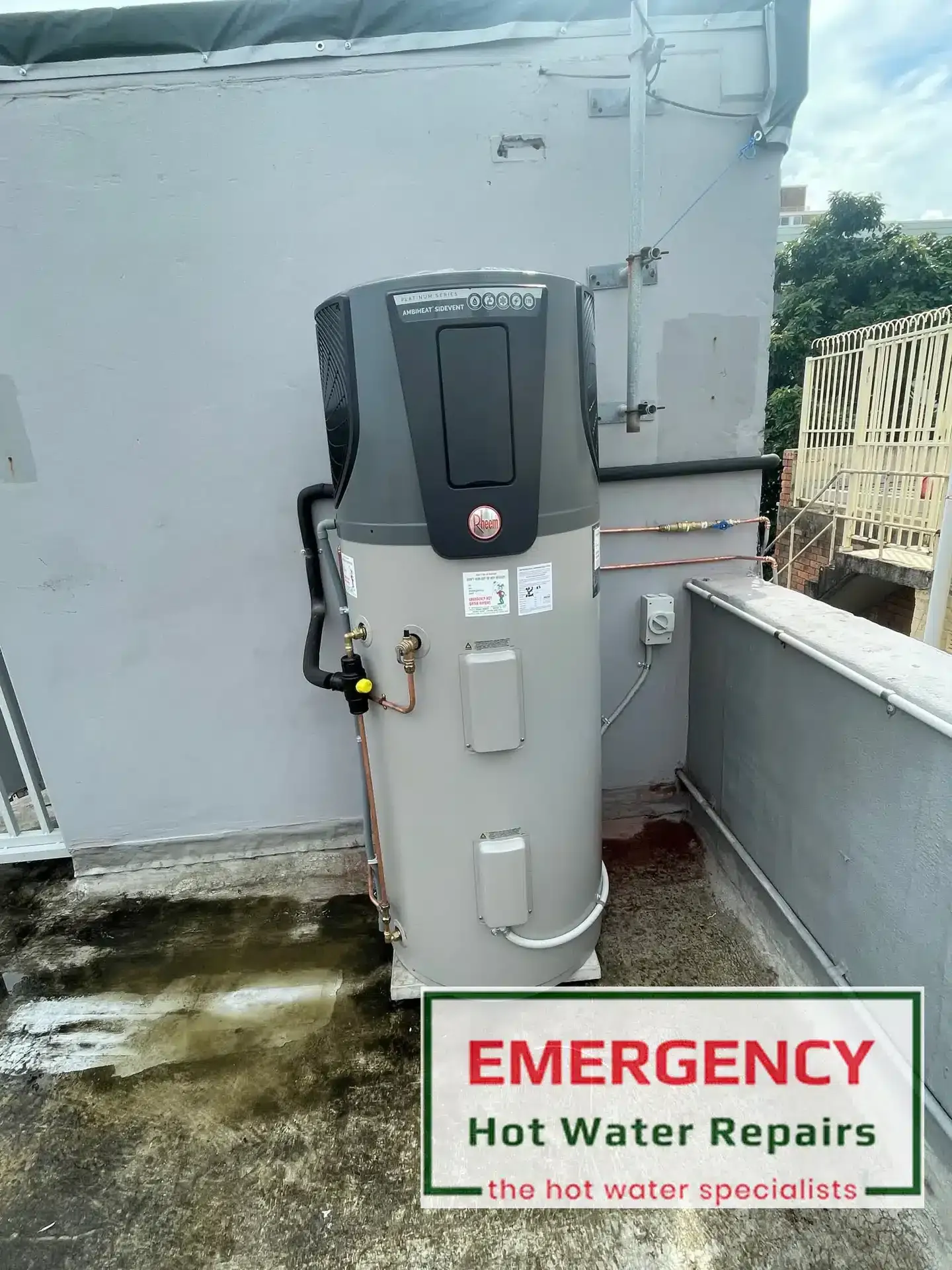
What is a heat pump hot water system and how does it work?
A heat pump uses a fan, refrigerant circuit and compressor to collect heat from the surrounding air and transfer it into the water. It uses electricity to move heat rather than creating all the heat directly, making it far more efficient than a standard electric element. Read more about heat pump hot water.
Are heat pump hot water systems worth the investment?
They are often worthwhile for households with moderate to high hot water use, especially when replacing standard electric storage or when daytime solar power is available. The higher purchase price needs to be weighed against rebates, expected energy savings, noise, space and future servicing.
How much electricity does a heat pump hot water system use?
A quality heat pump can use roughly one-quarter to one-third of the electricity required by a conventional electric storage heater for the same hot water output. Actual consumption depends on household use, air temperature, set point, unit efficiency and how often the boost element operates.
Will a heat pump work during winter or in cold weather?
Yes. Quality Australian-spec systems operate through Sydney winters, although efficiency and recovery can reduce as air temperature falls. Most include an electric boost element for unusually cold conditions or high demand. Read more about heat pump hot water.
Can I run a heat pump hot water system from my solar panels?
Yes. Setting the heat pump to run during daylight hours allows it to use rooftop solar generation. Because it consumes relatively little electricity while heating, the combination can produce very low hot water running costs.
Are heat pump hot water systems noisy?
They make fan and compressor noise, broadly comparable to a small air conditioner. Quality models are often around 40 to 50 dB, but placement near bedrooms, neighbours or enclosed courtyards still needs consideration.
How long do heat pump hot water systems last?
A quality system can commonly last 10 to 15 years, with tank life influenced by water quality and corrosion protection. Fans, compressors, sensors and control boards may require repair during that period.
Can a heat pump replace my existing electric storage hot water system?
Yes. Replacing electric storage with a heat pump is usually straightforward when there is suitable outdoor space, airflow, drainage and electrical supply. The larger physical size and condensate drain must be allowed for.
Which heat pump hot water system is best for my home?
The best system depends on household size, recovery needs, noise sensitivity, available space, warranty support and local spare parts. Established brands with Australian service support are generally safer choices than very cheap units with uncertain parts availability.
Solar
9 common questions about solar.
How does a solar hot water system work?
Solar collectors absorb heat from sunlight and transfer it to stored water, either directly or through a pumped circuit. An electric or gas booster heats the water when solar energy is insufficient. Read more about solar hot water.
Why is my solar hot water system not producing enough hot water?
Possible causes include cloudy weather, a failed circulation pump, airlock, damaged collector, sensor fault, scale, booster failure or unusually high demand. Checking whether the booster and circulation system operate helps narrow it down.
Why is my solar hot water booster running all the time?
The timer or controller may be set incorrectly, a sensor or circulation fault may be preventing solar gain, or household demand may exceed the available solar heat. Continuous boosting defeats much of the system’s energy-saving benefit.
How can I tell if my solar hot water booster has failed?
If the system performs poorly after cloudy weather and the booster indicator or circuit appears normal, the element, thermostat, gas booster or controls may have failed. Electrical or gas testing is needed to confirm it. Read more about solar hot water.
Should I repair my existing solar hot water system or replace it?
Repair is often sensible when the tank and collectors are sound and the fault is a pump, sensor, valve or booster. Replacement becomes more attractive when the tank leaks, collectors are badly damaged, parts are obsolete or several major components are failing.
Can I replace a solar hot water system with a heat pump?
Yes. A heat pump avoids roof collectors and can work very well with rooftop solar electricity. Removal of the old collectors, roof penetrations, electrical arrangements and the available ground location must be assessed.
How long does a solar hot water system last?
Many systems last around 10 to 20 years, but tanks, collectors, pumps, valves and boosters age at different rates. Coastal exposure, water quality and maintenance strongly affect service life.
Can hail damage solar hot water collectors?
Yes. Severe hail can crack glass collector panels or damage evacuated tubes. Damage may be obvious, or it may appear later as reduced performance or leakage.
Is a solar hot water system still worth installing today?
It can be, particularly on a suitable unshaded roof with high hot water demand. However, modern heat pumps paired with solar PV are often simpler and more flexible, so both options should be compared for the individual property.
Brands
10 common questions about brands.
Which hot water system brand is the most reliable?
Reliability depends on the specific model, correct sizing, installation quality, water pressure and available service support. Established brands with local spare parts and technicians are usually a safer long-term choice than selecting on purchase price alone. Read more about Rheem hot water.
What is the difference between Rheem, Rinnai, Dux, Bosch, Thermann and Vulcan hot water systems?
Each brand offers different strengths across storage, continuous-flow and heat-pump systems. Rheem and Dux have broad Australian ranges, Rinnai and Bosch are well known for continuous flow, while Thermann and Vulcan cover value-focused options. The best choice is the model that suits the site and has dependable local support.
Which hot water system offers the best warranty?
Warranty length varies by product category and often separates the tank, labour and component coverage. A long headline tank warranty is not the same as full parts-and-labour coverage, so the detailed terms and local service network matter.
Are spare parts still available for older hot water systems?
Parts remain available for many older systems, especially common valves, thermostats and elements. Brand-specific gas controls, heat exchangers, circuit boards and discontinued heat-pump components become harder to source as models age. Read more about Rheem hot water.
Can you repair older or discontinued hot water system models?
Yes, when safe compatible parts are available and the repair is economical. If a critical part is obsolete, modifying the heater with an unsuitable substitute is not appropriate, and replacement may be the only reliable option.
Which hot water brands do you repair and install?
The team works on major brands including Rheem, Rinnai, Dux, Bosch, Aquamax, Vulcan, Thermann, Stiebel Eltron, Wilson and Servgas, along with many older systems.
Will installing a different brand require major plumbing changes?
Not necessarily. Like-for-like models often connect with modest pipe alterations, but dimensions, valve positions, flues, power, gas input and clearances vary. A different technology or capacity can require more substantial changes.
Can I replace my existing hot water system with a different brand?
Yes. You are not locked into the original brand. The replacement should be selected for capacity, dimensions, energy source, warranty, parts support and installation requirements.
Which hot water brand is best for Sydney homes?
There is no single best brand for every Sydney home. Coastal exposure, available space, household size, energy tariff, solar panels and service access all affect the choice. Proven local support is particularly important.
How do I identify the make, model and age of my hot water system?
Look for the data plate or rating label on the side, front, inside a cover or near the connections. It normally lists the manufacturer, model, serial number, capacity and approval details. A clear photo allows the model and approximate age to be checked.
Running Costs
10 common questions about running costs.

How much does it cost to run a hot water system?
Running cost depends on hot water use, energy tariff, system efficiency, climate and losses from storage and pipework. The energy label or manufacturer data provides a starting point, but household shower duration and flow rate often have the greatest practical impact.
Which type of hot water system is the cheapest to run?
A well-sized heat pump using daytime solar is often among the cheapest options to operate. Solar thermal can also be inexpensive in good conditions, while efficient gas continuous flow may suit homes with low standby demand. Upfront and maintenance costs must be considered alongside energy use.
How can I reduce my hot water energy bills?
Use efficient shower heads, shorten showers, repair leaking hot taps, run heat pumps during solar-production hours and keep temperatures and timers correctly set. Replacing an oversized or inefficient old heater can also reduce losses.
Will installing water-saving shower heads make my hot water last longer?
Yes. A 50-litre tank delivering 10 litres per minute is emptied far faster than the same tank supplying 7 litres per minute. Lower flow extends shower time and reduces the energy needed to reheat replacement water.
Does fixing leaking taps help reduce hot water costs?
Yes. A leaking hot tap wastes both water and the energy used to heat it. Even a modest continuous leak can repeatedly trigger a storage heater or continuous-flow unit.
Should I leave my hot water system on all the time?
Most modern systems are designed to remain on and cycle as required. Turning them off daily can be inconvenient and may save little, although timers can be useful for heat pumps, solar boosters and some off-peak arrangements.
Should I turn my hot water system off when I'm away on holidays?
For a longer absence, turning off an electric storage heater or placing a heat pump in holiday mode can reduce standby energy. Follow the manufacturer’s restart and hygiene instructions, and do not switch off equipment needed for frost protection.
Is off-peak electricity still worthwhile?
It can still be worthwhile when the tariff saving is significant and the tank is large enough to carry the household through the day. A small off-peak tank that repeatedly runs out may be less practical than a better-sized or more efficient system.
How much hot water does the average family use each day?
Usage varies enormously, but showers dominate most household hot water consumption. Flow rate multiplied by shower minutes gives the mixed-water volume, and only part of that volume comes from the hot tank depending on the temperatures.
How can I make the hot water in my tank last longer?
Reduce shower flow, shorten shower time, fix leaks, stagger high-demand use and ensure the heater is recovering properly. A correctly operating tempering valve also helps use the stored high-temperature water effectively.
Compliance
9 common questions about compliance.
Why does my new hot water system need additional valves or plumbing work?
Current standards and manufacturer instructions may require pressure control, isolation, non-return, tempering or expansion-control valves that were not fitted to an older installation. These protect the new heater, improve safety and make servicing possible.
What is a pressure limiting valve (PLV), and when is one required?
A PLV reduces excessive incoming mains pressure to a level suitable for the heater and its valves. It is required when supply pressure can exceed the appliance or installation limits and can reduce nuisance discharge and premature component failure.
What is an expansion control valve (ECV), and does my hot water system need one?
An ECV relieves cold-water-side expansion as the stored water heats. Whether one is required depends on local water authority conditions, the valve arrangement and manufacturer instructions.
Why does my indoor hot water system need a safety tray and drain?
A tray protects the building by collecting leakage from an indoor storage heater. Depending on the installation, it may need a compliant drain or an approved automatic shut-off device where gravity drainage is not possible.
Why does my relief valve discharge pipe need to be upgraded?
The pipe must discharge safely, remain visible where required, avoid creating a hazard and use suitable materials and fall. Old lines may be undersized, combined incorrectly, concealed or terminated in an unsafe location.
Can I replace my hot water system without upgrading old plumbing?
Only if the existing installation is safe, suitable and compliant for the new appliance. A licensed installer cannot knowingly reconnect a new heater to defective valves, unsafe flues or inadequate drainage.
Can my existing gas flue be reused?
Sometimes, but only when the flue type, size, condition, route, clearances and termination suit the new appliance and current requirements. Many newer gas heaters require a different approved flue system.
Why can't a new hot water system always be installed in exactly the same position?
The exact answer depends on the system type, age, installation and symptoms. A licensed hot water technician can inspect the unit, explain the cause and recommend the most practical repair or replacement option.
Will you explain any additional work before starting?
Yes. Extra work should be identified and priced before it proceeds wherever it can reasonably be foreseen. Hidden defects or conditions discovered after removal should also be explained before the scope changes.
Commercial
10 common questions about commercial.
Do you repair and replace commercial hot water systems?
Yes. Commercial work can include storage banks, continuous-flow manifolds, circulating pumps, heat exchangers, controls, valves and plant-room pipework. Diagnosis considers both individual appliances and the way the whole system operates. Read more about commercial hot water.
Can you maintain hot water systems for strata buildings?
Yes. Maintenance can cover central plant, common-property heaters, circulating loops and individual units, with reports supplied to strata management where required.
Do you provide scheduled preventative maintenance?
Yes. Preventative maintenance can include valve testing, burner inspection, pump checks, temperature and pressure readings, leak inspection, cleaning and documenting developing faults.
Can you service schools, hotels and aged care facilities?
Yes. Work can be planned around access, hygiene, continuity of service and the higher demand typical of schools, accommodation, healthcare and aged-care sites. Read more about commercial hot water.
Can you work directly with strata managers and real estate agencies?
Yes. The office can coordinate access, tenant communication, approvals, quotations, invoices and written findings directly with property and strata managers.
Can you prepare written reports for insurance or strata?
Yes. Reports can record the observed condition, diagnosis, safety or compliance concerns, repairability and recommended work, supported by photos where useful.
Can you replace multiple hot water systems at the same time?
Yes. Staged or simultaneous replacement can be planned around building demand, access, lifting, shutdowns and temporary continuity arrangements.
Can replacement work be completed with minimal disruption?
Usually. Work can be staged, scheduled during lower-demand periods and planned to preserve partial service where the plant configuration allows. The practical shutdown window is discussed before work.
Do you offer ongoing servicing agreements?
Yes. Service intervals and scope can be tailored to the equipment, usage and consequences of failure, with reminders and condition reporting.
Can you improve the efficiency of older commercial systems?
Often. Improvements may include correcting circulation, replacing inefficient pumps or controls, insulating pipework, fixing failed non-return valves, tuning burners, reducing excessive temperatures or replacing obsolete plant.
General
3 common questions about general.
What areas do you service?
Emergency Hot Water Repairs is based in Kingsford and primarily serves Sydney’s Eastern Suburbs and nearby inner-city areas. Availability outside the core area depends on the job and schedule. Read more about book online.
Why should I choose Emergency Hot Water Repairs?
The business specialises in hot water rather than general plumbing, with more than 40 years of experience across repairs, replacements and commercial systems. Customers also benefit from same-day availability, licensed technicians and a strong local review history.
How do I book a hot water repair or replacement?
Call 02 9344 6602 or use the online booking form. Providing photos of the heater, data plate, leak and surrounding area helps the team assess the job before attendance.
Still need help with your hot water?
Call our Sydney hot water specialists or book online for a fast response.